Classical Pearls - Single Herb Extracts
Sha Ren (Xi) Single Herb Extract, 100g
Sha Ren (Xi) Single Herb Extract, 100g
Impossible de charger la disponibilité du service de retrait
Promotes the flow of qi, warms the middle, transforms dampness, improves the appetite
Promotes the movement of Qi, aromatically transforms Dampness, strengthens the Spleen, and stops vomiting
- Spleen/Stomach Qi Stagnation or Dampness Distressing the Spleen/ Stomach with distention and pain, in the epigastrium and abdomen, anorexia, vomiting, and diarrhea
Warms the Middle and stops diarrhea
- Diarrhea from Spleen Cold
Calms the fetus and prevents miscarriage
- Restless fetus or morning sickness
Prevents Stagnation from tonic herbs
- Middle Jiao Stagnation due to herbal tonification
The food grade herb Sharen (Amomum) is one of the most common ingredients in Chinese herbal prescriptions designed to treat symptoms of poor digestion, i.e. poor appetite, nausea, bloating, diarrhea, and other signs of middle burner weakness. Since it is a common spice in the cuisines of Southeast Asia, it is considered especially safe for children and pregnant women.
The flavor of the medicinal pod of the plant is complex and highly aromatic, and has been classified through the ages as pungent, bitter, sour or salty by different classical herb primers. The herb’s major function is to warm Spleen cold, transform Spleen damp, and descend counterflow in the Stomach, making it a primary choice for everyday digestive discomfort caused, for instance, by food stagnation or alcohol poisoning.
Li Shizhen, author of the authoritative 17th century materia medica Bencao gangmu, pointed out another important aspect of the herb’s medicinal function that has become almost forgotten in modern times: “Sharen has the capacity to draw the ingredients of a formula into the lower Dantian… When producing Kidney tonics such as Dihuang Wan, therefore, a small amount of Sharen is customarily added during the steaming process, so that the remedy’s effect may be more forcefully directed to the lower regions of the body.” The fact that certain species of Amomum have the potential to not only regulate qi flow in the upper and middle burners, but also connect the middle and lower burners was later expanded upon by the 19th century scholar physician Zheng Qin’an, founder of the Fire Spirit School of Sichuan herbalism. Qianyang Dan (Submerge the Yang Pellet), one of his best-known remedies, utilizes Sharen not in its regular role as an aromatic digestive, but as a minister herb enhancing the downward momentum and the Dantian warming properties of the lead medicinal Fuzi. Zheng pointed out, however, that only a unique variety of Sharen processed in a specific way has this effect: Xi Sharen fried in salt.
The Amomum pod has been cultivated for centuries in Guangdong province, a variety referred to as Yangchun Sharen (Sharen from Yangchun; Amomum villosum) by herb traders. In addition, the spice pod has also been wild-crafted in the dense tropical forests connecting the Southwest Chinese province of Yunnan, Burma, Laos, and North Vietnam. The wild variety represents the fruit of a slightly different species, which is called Lüqiao Sharen (Green Shell Sharen; Amomum xanthioides) or Xi Sharen (Western Sharen), the name used by Zheng Qin’an. Until 30 years ago, this variety was highly valued by Sichuan herb traders, who sent buyers to the Xishuangbana region of Yunnan at harvest time in August. In recent years, however, laboratory tests have shown that certain essential oils are more concentrated in the cultivated Yangchun Sharen from Guangdong, driving up prices for this variety. This economic development prompted Cantonese entrepreneurs to plant their cultivated variety in the lush jungle terrain of the wild growing Lüqiao Sharen in Southern Yunnan, an area best known in the West as the origin of premium Pu’er tea. As a result, local peasants have not only stopped collecting the Lüqiao variety, but have begun to actively destroy wild plants when they come across them-for fear that the native variety may be cross-pollinating the cultivated variety from Guangdong, which now fetches a higher price on the market.
In addition, the natural environment in Southern Yunnan has undergone dramatic changes in recent years, prompting the Chinese government to commission an official scientific inquiry. The report notes that a dramatic increase in air pollution, climate change, decreasing rainfall and deforestation for advancing banana plantations has greatly deteriorated growing conditions for native Sharen. Therefore, the wild variety of Xi Sharen, still valued by doctors of the Fire Spirit School lineage for its “salty” quality and the associated “Dantian effect,” now needs to be imported from the comparatively healthy forest regions across the border in Burma, Laos, and North Vietnam.
Classical Pearls is pleased to offer genuine wild-crafted Xi Sharen extract from the forests of Northern Burma.
Processing follows traditional instructions, by first roasting the fruit in front of a wood fire to bring out the characteristic aroma and medicinal property of the herb. Secondly, the fruit's shell is removed, comprising 50% of its weight and still containing some essential oils, prompting most modern herb traders to break with tradition and leave it on. Finally, the fruit kernels are being fried in water from Tibetan salt lakes to increase the herb’s potential to draw energy down into the lower Dantian.
English Name: Amomum Fruit, Grass-of-Paradise Fruit, Cardamon, Wild Cardamon Pod, Fructus Amomi
Chinese Name: Sha Ren,
Unit Size: 100 Grams
Potency: 10:1
Taste: Acrid; Aromatic, Warm in temperature
Properties: Classical Pearls are not eligible for discounts.
Materia Medica: Transform Dampness
Contraindications: Contraindicated for those with Yin Deficiency with Heat signs. Contraindicated for those with Blood Deficiency. Contraindicated for those with Blazing Fire. Contraindicated for those with abdominal pain due to Fire. Contraindicated for those with diarrhea due to Summerheat. Contraindicated for those with coughing and rebellious Qi due to Lung Heat. Use caution during pregnancy.
Ingredients
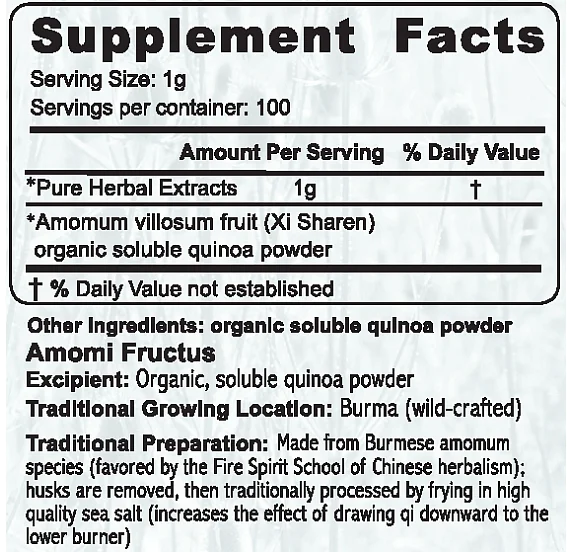
Sharen (Xi) 5:1(Burmese) Amomum Amomi Fructus Amomum villosum fruitClassification:Herbs that Descend the Yang and Regulate Counterflow Excipient:Organic, soluble quinoa powderGrowing Location:Burma (wild-crafted)Traditional Preparation:Made from Burmese amomum species (favored by the Fire Spirit School of Chinese herbalism); husks are removed, then traditionally processed by frying in high-quality sea salt (increases the effect of drawing qi downward to the lower burner).
Share