Kan Herbals
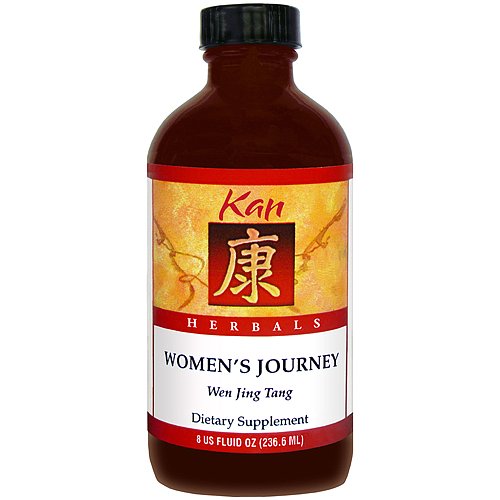
Women's Journey, (8 oz)
Women's Journey, (8 oz)
Couldn't load pickup availability
Warms the channels, menses, and removes Cold. Nourishes the Blood and removes Blood stasis. Regulates the Conception (Ren mai) and Penetrating (Chon mai) vessels. Replenishes Kidney Yin and Yang.
Women’s Journey was designed to treat Cold and deficiency of the Conception (Ren mai) and Penetrating (Chong mai) vessels. When these vessels are Cold and deficient, the Blood and Qi flowing through them stagnate, leading to blood stasis, which in turn hampers the production of new Blood. Since Blood's role includes moisturizing and cooling the body, Blood deficiency can cause Heat symptoms. Consequently, Women’s Journey also targets imbalances associated with Heat.
PHYSICAL INDICATIONS
Blood represents the aspect of being that supports comfort and a sense of completion within oneself. For women of menopausal age, physical and emotional changes due to disruption of the Blood cycle may be of great concern. When a woman presents with patterns of excess and deficiency, or Heat and Cold simultaneously, the practitioner will need to address both imbalances. Women’s Journey is designed to alleviate such conflicting signs as an occasional cold abdomen, pale tongue color and complexion, blushing, sweating, fatigue, and disturbed sleep. Although this formula is designed primarily for women, it may also be used for men with Cold paralysis and Heat agitation.
PSYCHOLOGICAL AND TRANSFORMATIONAL INDICATIONS
This formula may be especially helpful for individuals struggling with adapting to transitions and environmental changes. Women’s Journey is primarily designed for women experiencing menopause who display both Cold and Heat symptoms.
ORIGIN AND DEVELOPMENT
Women’s Journey (Wen Jing Tang) is based on the formula “Warm the Menses Soup” from Essentials from the Golden Cabinet, written by Zhang Zhong-Jing during the Eastern Han Dynasty. The original formula has been modified by adding Anemarrhena rhizome and Curculigo rhizome to enhance its Heat- and Cold-clearing actions, and Oyster shell has been added to calm the Spirit (Shen) and benefit the Yin.
ABOUT THE HERBS
Oyster shell calms and settles the Spirit (Shen) and is used to treat occasional anxiety and insomnia. It is salty, astringent, and cool, and it enters the Liver and Kidney meridians.
Dong quai root tonifies the Blood and regulates the menses. It is also an important herb for invigorating the Blood and dispelling Blood stasis. It is sweet, acrid, and warm, and enters the Heart, Liver, and Spleen meridians.
White peony root nourishes the Blood, pacifies the Liver, and alleviates stagnation. It is used to treat deficient Blood when combined with the other tonifying herbs in this formula. It is bitter, sour, and cool, and enters the Liver and Spleen meridians.
Tree peony root bark assists in dispelling Blood stasis, clearing deficient Heat, and cooling the Blood. It is acrid, bitter, and cool, and enters the Heart, Liver, and Kidney meridians.
Ophiopogon tuber nourishes the Yin and clears deficient Heat. It is sweet and cool, and enters the Heart, Lung and Stomach meridians.
Evodia fruit warms the menses, dispels Cold, alleviates stagnation, and moves Qi. Combined with Chinese cinnamon twig, this herb addresses Blood stasis caused by Cold. It is acrid, bitter, and hot, and enters the Stomach, Spleen, Liver, and Kidney meridians.
Chinese cinnamon twig is used to warm the channels and disperse Cold that may be obstructing the Blood. It is sweet, acrid, and warm, and enters the Lung and Bladder meridians.
Ginger rhizome combines with Chinese licorice root and rhizome, as well as White Asian ginseng root and rhizome, to harmonize the Stomach and Spleen and tonify Qi. This supports the productive transformation of Yang into Yin, resulting in sufficient Blood. It is acrid and hot and enters the Lung and Stomach meridians.
Chinese licorice root and rhizome assists the other Spleen herbs and harmonizes all the herbs in this formula. It is sweet and neutral, and enters all twelve meridians.
Anemarrhena rhizome is the first addition to this traditional formula, as are all the following herbs. Anemarrhena rhizome clears Heat and quells Fire while moistening dryness and nurturing Yin. It is bitter and cold and enters the Lung, Stomach, and Kidney meridians.
Phellodendron bark will temper deficient Kidney Fire, addressing occasional night sweats and hot flashes. It is bitter and cold, and enters the Kidney and Bladder meridians.
Morinda root is classified as a Kidney Yang tonic and is used to fortify Yang and strengthen the sinews and bones. It is acrid, sweet, and warm, and enters the Liver and Kidney meridians.
Curculigo rhizome is similar in action and use to Morinda root, as it warms the Lower Burner by tonifying the Yang. We have added Curculigo rhizome, along with Morinda root, two Kidney Yang tonics, to address the cold sensations that occur with Hot and Cold Blood syndromes. It is acrid and warm, and enters the Kidney and Liver meridians.
Raw Rehmannia root cools the Blood, nourishes the Yin, and generates fluids. It is bitter and cold and enters the Heart, Liver, and Kidney meridians.
White Asian ginseng root and rhizome strongly tonifies Qi. White Asian ginseng root and rhizome, Chinese licorice root and rhizome, and ginger rhizome are used in Women’s Journey to strengthen the Stomach and Spleen for ample Blood production. It is sweet and warm, and enters the Spleen and Lung meridians.
Lycium fruit nourishes and tonifies the Liver and Kidneys. It tonifies Blood and benefits the Essence (Jing). It is sweet and neutral, and enters the Liver, Lung, and Kidney meridians.
Processed Polygonum multiflorum root, in tandem with Lycium fruit, tonifies the Liver and Kidneys, nourishes Blood, and benefits Essence (Jing). It is bitter, sweet, and slightly warm, and enters the Liver and Kidney meridians.
English Name: Women's Journey, (8 oz)
Chinese Name: wen jing tang
Unit Size: 8 oz.
Potency: 8:1
Properties: Supports peaceful sleep and healthy menopause and menses, with both hot and cold signs present
Actions: Warms the channels and menses and removes Cold, nourishes the Blood, transforms Blood stasis, regulates the Chong and Ren channels, replenishes Kidney Yin and Yang
Pattern: Cold blocking the Chong and Ren Channels, Blood Stasis in the Lower Burner
Chinese Symptomology: Conflicting symptoms of excess and vacuity, Heat and Cold. Cold abdomen, pale complexion, flushing, sweating, fatigue and disturbed sleep. Biomedical uses include menopause, chronic infertility, abnormal uterine bleeding, menorrhagia and amenorrhea in younger women presenting with signs of both Heat and Cold
Ingredients
Herb: Oyster shell, Dong quai root, White peony root, Tree peony root bark, Ophiopogon tuber, Evodia fruit, Chinese cinnamon twig, Ginger rhizome, Chinese licorice root and rhizome, Anemarrhena rhizome, Phellodendron bark, Morinda root, Curculigo rhizome, Raw rehmannia root, White Asian ginseng root and rhizome, Lycium fruit, Processed polygonum multiflorum root (soybean)Herb (Pinyin): Duan mu li, Dang gui shen, Bai shao, Mu dan pi, Mai men dong, Wu zhu yu, Gui zhi, Gan jiang, Gan cao, Zhi mu, Huang bai, Ba ji tian, Xian mao, Sheng di huang, Bai ren shen, Gou qi zi, Zhi he shou wu
Share